Monday, August 18, 2014

Every Roll has Consequences

Getting ready to kick off a D&D 5e campaign, I am going to bring in many of the principles that I learned from running Dungeon World.  One concept from DW that really stuck with me is that every roll has potential consequences.

Too many times, when the party wants to make a Check, if one PC fails, someone else chimes in, "I'll try it."  The player must be thinking, "After all, why not, there's no risk in failure so I might as well try too."

In Dungeon World, every roll can result in a success, a partial success, or a failure.  A partial success leads to a hard bargain or tough decision.  A failure means that the GM can make something bad happen.  That means, the player needs to think twice before they flippantly decide that they want to make a roll.

In practice, this led to interesting developments in my previous Dungeon World game.  One of the characters rolled to explore some ruins, and another character decided to roll to aid them.  The aiding player rolled a failure.  In D&D this usually just means, too bad, you couldn't help.  In Dungeon World, it meant that the player suffered a debility as he sprained his ankle trying to navigate some difficult terrain while he tried to help.  After that experience, the player didn't offer to help again.

These consequences add tension and *decision making* into the game.  It makes it a decision whether to make a roll or not, rather than a "why not."

In the D&D Next playtest packets, there was even an optional mechanic that formalized this, the Hazard rule for Ability Checks.  If you rolled a certain number below the required DC, something bad happens.  I hope that this optional rule survives in the DMG!

I'll be adopting the Hazard rule for 5e.  If the player fails a Check by more than 5, something bad will happen.  For example, if they're exploring a swamp and someone makes a Knowledge Check, and fails by 6 or more, the party might here some loud croaking sounds in the distance.  This foreshadows the presence of Giant Toads in the area.  This is akin the the Signs of Doom advice from Dungeon World.

Consider using a "Hazard" style rule in your games to keep the tension level high, and make each roll a DECISION and not a "why not".

Friday, August 8, 2014

Fire Elf - D&D 5e Subrace

You come from a branch of Elves that have migrated and adapted to the harsh deserts of the world.  Your skin is a coppery color, and your eyes might range from deep burnt orange to shimmering umber.

Ability Score Increase.  Your Charisma and Constitution scores increase by 1.

Fire Elf Weapon Training.  You have proficiency with the scimitar and the sling.

Heat Resistance.  You are resistant to fire damage.

Desert Native.  You have advantage on any Survival check related to a desert environment.

Ice Dwarf - D&D 5e Subrace

You are a member of the first primordial race, which mastered Elemental Magic as well as Necromancy, and carved out the Underdark before the Drow invaded it.

Alignment.  Most Ice Dwarves are firmly in the Lawful Evil camp.  But the Order of the Ancestors actively opposed this philosophy, and joined the Mountain Dwarves in a war against the Ice Dwarves.  This war purged most of the evil Ice Dwarves from the eastern part of the world.

Ability Score Increase.  Your Intelligence score increases by 1.

Icy Resistance.  You have resistance to cold damage.

Icecunning.  As Stonecunning, but also applies to ice and cold.

Saturday, August 2, 2014

My D&D 5e House Rules

The campaign will kick off in a few weeks and I'm compiling the House Rules for my flavor of 5e.  Slightly more gritty, a tad more old school.  Some of these rules were adopted from previous playtest releases and are likely to show up in the DMG, and others were stolen from Troll and Flame.

Slower Healing
You recover your Hit Dice during a Long Rest, not your full Hit Points.

Encounter Cantrips (Scrapped)
Cantrips are not at-will, but you regain them after a Short or Long Rest. (Note: this house rule was quickly scrapped.  I had the old damage potential of the play test cantrips in my mind, and found that the release cantrips were more well balanced.)

Consequences of Death
Being returned from the dead results in a loss of 1 random Ability point.

Non-Lethal Damage
If you decide to pull your punches before making an attack roll with a melee weapon (this incurs disadvantage) you can deal non-lethal damage.  If you don't pull your punches, then after a strike that brings the enemy to 0 HP, you must make a DC 12 INT(Medicine) check to avoid accidentally killing them.  If you're using a bludgeoning weapon, this is made at advantage.

Magic Item Attunement
You can attune to a maximum number of magic items equal to your Charisma modifier (minimum 1).

Monday, July 28, 2014

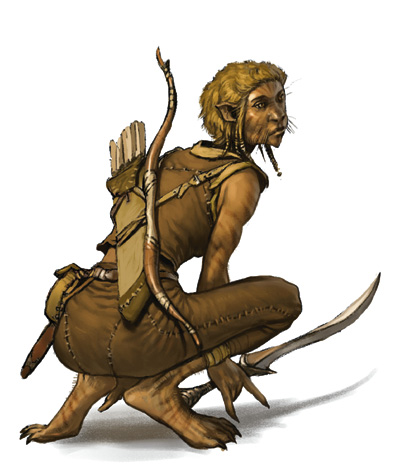
Cat Folk Race for D&D 5e

Cat Folk

Ability Score Increase.  Your Dexterity score increases by 2, and your Charisma score by 1.

Size.  Your size is Medium.

Speed.  Your base walking speed is 30 feet.

Darkvision.  You have superior feline vision in dark and dim conditions.  You can see in dim light within 60 feet of you as if it were bright light, and in darkness as if it were dim light.  You can't discern colors in darkness, only shades of gray.

Keen Senses.  You have proficiency in the Perception Skill.

Stalk.  You have proficiency in the Stealth Skill.

Languages.  You can speak, read and write Common and Felingua, the language of the Cat Folk.

Land on all Fours.  You are resistant to falling damage.

Pounce.  You double the distance that you can jump.

Tuesday, October 16, 2012

Using Google Translate to Obfuscate

Here's a little trick you can use to slightly obfuscate notes, journals, or any text that PCs might find in another language.


  • Paste the text of into Google Translate
  • Pick a foreign language and translate it
  • Copy the translated text and paste it back in
  • Translate this back to your native language
The resulting text will contain cool little quirks that will lend it an exotic and non-human feel.  Perfect for that note that the PCs find written by the Orc commander.

Example

Here's a note that the PCs in my D&D Next campaign might find:

My Lord,
We secured site.
Tenants under control.
Glaragula located book.
Magic stone is here, funnels power.
Ritual maybe only works here.
Many living dead ones still here.
We made four already.


I translated this to Arabic, and then the Arabic back to English, and this is what I now have to give to the players:

Lord,
We are securing the site.
Tenants under control.
The book is Glaragula.
Magic Stone is here, and the entrances to power.
Rituals may only work here.
Many of the dead who live here so far.
We made four already.


The gist is the same, but somewhat less clear.  Imperfect information.  Translation errors.  Great stuff!

Friday, June 15, 2012

Bean (or coin) Counting


I love resource management in D&D. Enforcing limited resources on the PCs provides tension to the game, and often forces them into situations where they have to make tough choices. The more interesting choices a player has to make in a game, the more engaged they become.

Types of Resources

There are many resources specified in the rules that are inherently limited, and thus subject to resource management. Some that come to mind are: money, hit points, hit dice (D&D Next), rations, arrows, torches, spells. In order to avoid having the game degenerate into a tedious session of bookkeeping, we need tools to help us manage these resources in game.

Physical Props

What I do to help alleviate the tedium is to use physical props to manage some of the more mundane resources I want to track. For example, I use poker chips to represent coins. When a PC has to hand over physical coins when paying for something, it's a much different feeling than erasing a number on their character sheet and writing a new one in. It's far more immediate and creates a feeling like they're actually spending money.

For money, I use red poker chips to represent copper, white for silver, and green for gold. I also use a black sharpie to write denominations like 5, 10, 25, etc. on the chips to make this easier to manage. Since I use a silver standard in my games (see below) copper is relevant.

I use black poker chips for hit points, toothpicks for arrows, and glass beads for rations. The players appreciate that they don't have to constantly scratch out or erase numbers on their character sheets.

I have another approach for gear, weapons, and other items the PCs carry. When someone gains an item, I quickly write it down on a half index card. I write down the item's name, it's weight, and any important properties it has, like damage for weapons, then hand the card to the player. A PC doesn't have an item unless they have the card! If the item has a number of uses, like vials of oil, I draw little circles on the card that the player can check off as uses are expended. When a PC loses an item, they really feel the loss because they have to hand that card back!

The Silver Standard

In previous campaigns, copper had always become somewhat of a worthless denomination, since prices are mainly expressed in gold. Players would even ignore any copper pieces found in treasures. That's why I adopted a silver standard in game. Basically, any book price listed in gold is actually silver, and any price listed in silver is actually copper. If a price is listed in copper, I make it 1 cp, or allow the copper piece to be physically split into quarters. But I hint that using quarters is for the poorest folk only, so the PCs always round up to 1 cp minimum.

Now, the PCs actually care about finding copper in treasures, and you should see their eyes light up when the find those elusive gold pieces, not to mention platinum!

Summary

Using physical props like poker chips provides a tactile element to the game that can produce more of an impact on a player when their PC gets wounded or spends money or other resources. For the resources that you as a DM feel are relevant and worth tracking, this technique can make resource management more painless, and even fun.